
- Home
- »
- Tajikistan
Targeted Social Assistance reform (TSA)
The EGED helped the Ministry of Health and Social Protection (MoHSP), the Ministry of Finance and Statistics Agency revise the TSA by:
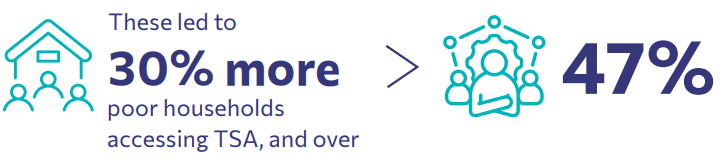
- improving the targeting of TSA assistance,
- doubling the TSA cash allowance to TJS 800/family,
- x4 times increase of the budget spend on TSA,
- a top-up cash for children under 16 (TJS 150) for households with two or more PWDs.
TSA eligibility now also entitles households to non-cash social benefits, e.g. subsidized medical treatment, higher education and scholarships for orphaned children, free vocational training, and other determined by subnational governments.
The reform expected to lift between 100,000 and 200,000 people out of poverty.
Through EGED, civil society and media built its capability to monitor the TSA delivery and improve the reach. Local CSOs:
- identified gaps in TSA implementation through 18 rounds of Third-Party Monitoring in three major provinces (Khatlon, DRS, Sughd),
- informed central/local governments and NDC Secretariat of the gaps in TSA delivery,
- reached over 30 000 people in local communities through over 20 awareness raising campaigns to explain TSA application,
- worked with MoHSP to embed civil society monitoring of TSA delivery in the 2024-2026 TSA State Programme.
Productive employment
The EGED is helping PWDs and other disadvantaged groups access the jobs - at least 6,000 beneficiaries expected to gain a form of employment by end 2025.
The review of the government employment policies has informed the civil society to advocate for 10 new KPIs on inclusion, productive employment, and social protection in the Government of Tajikistan 2026-2030 Mid-Term Development Plan (MTDP).
Strengthening predictive capacity
The CODI tool (Core Systems Diagnostic Instrument) has been introduced, which helps the Republic of Tajikistan to improve social protection systems by analyzing their strengths and weaknesses and proposing options for further action (comprehensive assessment of all elements and programmes of the system; coordination of national ministries, agencies and international partners; informing the Social Protection Action Plan of the Population Strategy in the Republic of Tajikistan)
Export support pilot: Access to global markets through e-commerce
The EGED programme funded the E-GATE initiative to open new markets for Central Asian producers through B2B online trading.
5 Tajik firms started B2B sales on global e-marketplaces reaching USD 16 million in deals (contracted and negotiated).
20% of supported firms created new e-commerce roles, 80% of whom are women.
Monitoring and measuring wellbeing
Poverty and middle-class measurement. Revision of methodologies to measure poverty and middle class done through EGED support, will help re-calculate the national poverty line and middle-class per international practice, and inform the future government policy to expand the middle class.
Poverty and Equity Assessment helped explore if economic growth in Tajikistan benefits all and what drives inequality. A set of recommendations made to the Government of Tajikistan to improve structural transformation and overreliance on remittances, reversal of jobless growth in private sector, social support to help leverage human development, and access to quality education.
The CODI Assessment (Core Systems Diagnostic Instrument) of social protection system identified the strengths and weaknesses across policy, institutional arrangements, delivery mechanisms, financing, and coordination. Four clusters of recommendations made to the Government of Tajikistan to improve the 2024-2026 Social Protection Strategy Action Plan and inform the next phase of social protection reform.
Listening to Tajikistan (L2T): Since 2020, the EGED funds the Listening to Tajikistan (Listening2Tajikistan: Survey of Wellbeing) implemented by the World Bank. A monthly survey of 2,500 households across the country to understand public perceptions of wellbeing, reforms, migration, employment, access to public services, household income, and food security. To date, L2T helped inform seven government policies. Interactive L2T dashboard open to public since summer 2025 (https://l2t.datamaven.ai/).
Country Gender Assessment identified disparities in economic opportunities between women and men. More than 20 policy recommendations to address gaps were put forward. The assessment fed into minimizing the list of banned jobs for women.
Protecting space for civil society, building resilience
The EGED supported the introduction of 30% membership quota for civil society organizations in the Interagency Working Groups (IWG) of the National Development Council (NDC) – the national platform chaired by the President to monitor the delivery of the National Development Strategy 2030.
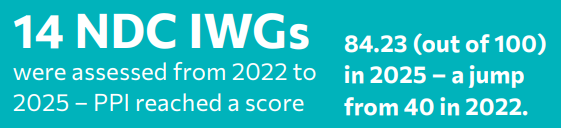
Through EGED, CSO sperformed monitoring of the employment and social protection KPIs of the Med-Term Development Programme 2021-2025 in half of the country’s districts. The EGED designed and launched a Platform Participation Index (PPI) – a localised mechanism to measure inclusiveness, transparency, and responsiveness of public-private dialogue platforms.
Using data to strengthen accountability
The EGED built data use capacity of a dedicated

(text and visual) and analytical articles on TSA, social protection, tax reforms, productive employment, expansion of the middle-class, and government social services procurement were broadcasted on state television and published on social media, reaching an audience of about 4,000,000.
Seven ‘Tavozun’ Press Club sessions supported through EGED offered journalists:
- better access to information on select government economic policies,
- open space to engage with public officials.
CSO financial sustainability
The EGED supports CSOs to become financially resilient by:
- tailored Social Entrepreneurship Pre-Acceleration Programme (SEPP) training and blended financing to CSOs,
- and policy advocacy for tax reliefs.
10 CSOs have already diversified funding sourcing – 78% of income comes from the private sector.
The policy advocacy resulted in three amendments to the Tax Code:
- income tax exemption for organizations with at least 50% PWD employees, and property tax exemption for similar organizations using real estate for core functions,
- simplified tax regime eligibility for social entrepreneurs meeting the PWD employment and payroll thresholds,
- and first ever Social Entrepreneurship Law.
Pillar 1
Pillar 2
(2021 – 2025)
(2025 – 2026)
Beneficiary partners:
|
Implementor
|
Contacts
|
|---|---|
|
FCDO |
Sherzod Shamiev |
|
The World Bank |
Alisher Rajabov |
|
ACTED |
Nasima Nazrieva |